
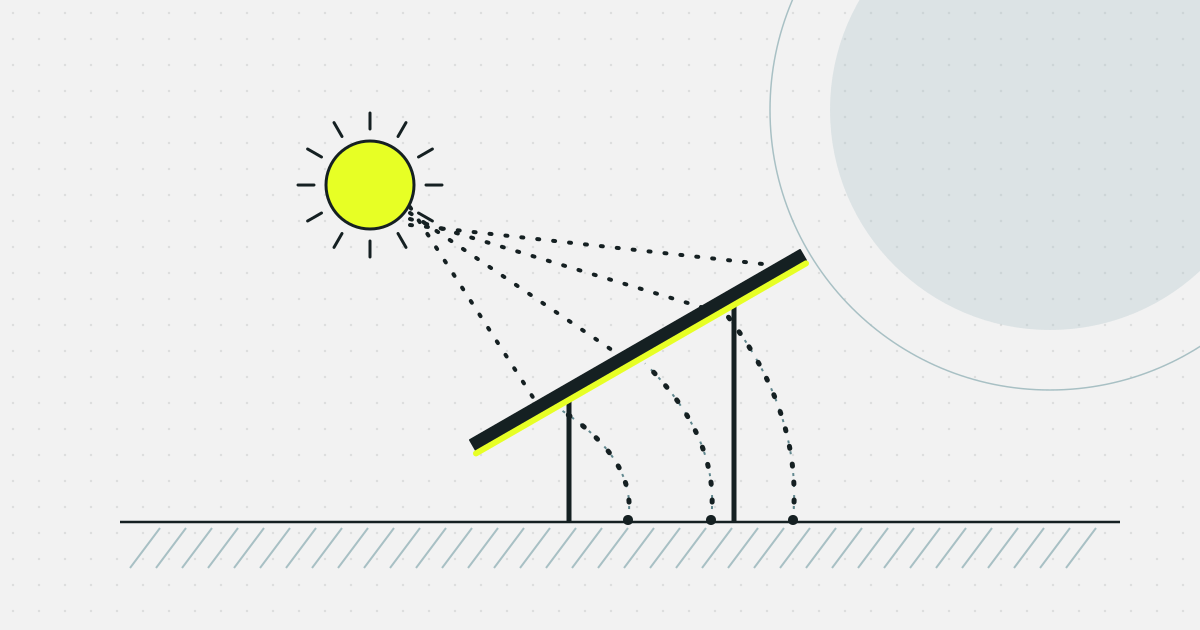
Bifacial modules pay off where their back side has something to produce energy from: over a bright, reflective surface, on structures raised above the ground or vertical ones, with good ventilation behind the module. In a typical rooftop installation, where the back of the panel sits close to a dark covering, the extra yield is small — and then the premium for bifaciality pays back slowly or not at all. So it is not the module itself that decides, but the conditions it works in.
What is the difference between a bifacial and a monofacial module?
A monofacial module produces energy only from the front — the back is covered with an opaque layer. A bifacial module has cells active on both sides and a transparent back (glass or transparent film), so it can use light that reflects off the ground and reaches the rear of the panel. This extra yield is called the bifacial gain and is expressed as a percentage.
Crucially, the bifacial gain is not a fixed feature of the module — it depends on how much light actually reaches its back. The same bifacial module over white gravel gives a noticeable energy bonus, while bolted flat over dark roofing membrane gives almost none. Comparing modules purely by nominal power without accounting for mounting conditions is therefore misleading.
What determines the real gain from bifaciality?
The most important factor is albedo — the ability of the surface to reflect light. Bright surfaces — white gravel, light concrete, snow, a light roof membrane — reflect a lot of light towards the back of the module and increase the bifacial gain. Dark surfaces — grass, dark roofing, asphalt — reflect little, so the gain is negligible.
The second factor is the distance of the module back from the surface and the shading of that space. A module raised high, with free, well-lit space underneath, uses bifaciality far better than one lying just above the surface. It is also important that the mounting structure and cabling do not shade the back of the panel — any shadow at the rear reduces the effect.
Installations where bifaciality works best
Bifaciality works strongest in ground installations over a bright surface, in vertical systems (where both sides are fully exposed), on flat roofs with a light membrane and a structure that lifts the module, and in regions with long-lasting snow cover. That is where the premium for a double-sided module pays back fastest.
When does bifaciality not pay off?
In a classic pitched-roof installation, where the module sits close to a dark covering, the back of the panel is in shadow and has nothing to produce extra energy from. In such a case the bifacial gain is around a few percent or lower — often too little to justify the higher price of the module and the glass-glass construction. Similarly over a dark surface, with low mounting or strong rear shading — bifaciality stays mostly on paper.
It is also worth remembering that bifacial modules are usually a glass-glass construction, which tends to be heavier than the classic glass-film one. On roofs with limited load capacity this extra weight can be a significant argument — regardless of the yield question.
Mono versus bifacial — when to choose which
The comparison below organises the typical scenarios. Under the table we return to the practical conclusion.
| Installation conditions | Recommendation | Why |
|---|---|---|
| Ground, bright surface, high mounting | Bifacial | Large gain from ground reflection |
| Vertical installation | Bifacial | Both sides fully exposed |
| Flat roof, bright membrane, raised modules | Usually bifacial | Moderate but real gain |
| Pitched roof, module close to covering | Usually monofacial | Rear in shadow — negligible gain |
| Dark surface, low mounting | Monofacial | No real gain from the back |
The practical conclusion is simple: bifaciality is not a better module in every situation, but a technology that needs the right conditions. Well chosen, it gives a real, measurable energy bonus. Chosen without regard for the surface and mounting, it is an expense that does not pay off.
What does this mean for the installer and the trading company?
For the installer it means a simple rule: mounting conditions first, module technology second. Before proposing a more expensive bifacial module to a customer, check the surface, the type of structure, and whether the back of the panel will have access to reflected light. This allows honest advice and avoids situations where the customer overpays for a feature they will not use.
The Photonica offer includes both monofacial and bifacial modules from leading manufacturers such as Jinko, LONGi and JA Solar — which lets you match the technology to the specific project, not the other way round. The sales team helps with selection for a given installation type and surface.