
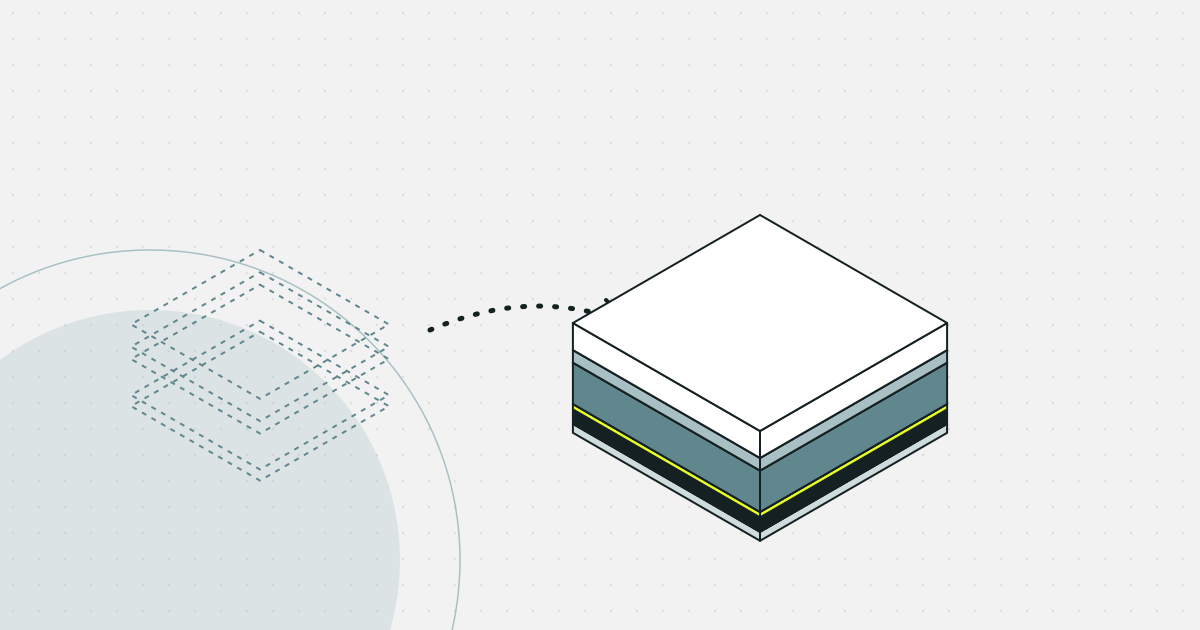
TOPCon is a newer PV cell technology that offers higher efficiency and better behaviour at high temperatures than the older PERC — which is why leading manufacturers are shifting their main production to it. For the installer this means that new modules from the same tier usually deliver slightly more energy from the same area, with similar mounting. PERC is not disappearing overnight, but the market direction is already clear.
What is the difference between TOPCon and PERC?
PERC (Passivated Emitter and Rear Cell) was the standard for years — it improved the efficiency of classic cells thanks to an additional passivation layer at the back. TOPCon (Tunnel Oxide Passivated Contact) goes a step further: it uses a thin oxide layer and additional contact passivation, which reduces losses and squeezes more energy out of the cell.
In practice this translates into three things: higher module efficiency (more watts from the same area), a lower temperature coefficient (less power drop in the heat), and usually better behaviour under diffuse light. For the end customer this means a slightly higher annual yield, especially on hot, sunny days when older modules lose more power.
Why are manufacturers switching to TOPCon?
The main reason is both economic and technological: PERC production lines have reached the limit of their capabilities, while TOPCon delivers a real parameter improvement with mounting that looks almost identical for the installer. Manufacturers such as Jinko, LONGi and JA Solar are moving their main production to TOPCon, which means this technology increasingly ends up in the standard offer rather than as a premium option.
This direction matters because it changes what we consider a standard module. Not long ago the default choice was PERC, and TOPCon was the upgrade. Today the proportions are reversing — and it is TOPCon that is becoming the baseline against which other solutions are compared.
What does this change mean in practice for selection?
For the installer the most important news is reassuring: switching to TOPCon does not require changing the mounting method or the structures. The modules have similar dimensions and mounting, so knowledge and hardware remain valid. What mainly changes is that at a similar price the customer gets a higher-efficiency module — which is worth communicating as an advantage.
It is, however, worth paying attention to the datasheet parameters rather than the technology name alone. Not every TOPCon module is automatically better than every PERC — the specific values of efficiency, temperature coefficient and warranty matter. But when comparing models in the same price tier, TOPCon usually comes out ahead.
TOPCon versus PERC — the key differences
The comparison below summarises the practical differences. Under the table we return to the selection conclusion.
| Feature | PERC | TOPCon |
|---|---|---|
| Module efficiency | High | Higher |
| Temperature coefficient | Standard | Better (smaller drop in heat) |
| Diffuse-light yield | Good | Usually better |
| Mounting method | Standard | Practically the same |
| Market position | Declining standard | New standard |
Conclusion: TOPCon is not a mounting revolution, but an evolution of parameters. For the installer it means a better module for the same work, and for the customer — a slightly higher yield. The market direction is unambiguous, so it is worth planning offers with TOPCon as the default option.
What does this mean for the trading company?
For distribution the switch to TOPCon is a signal to build the offer around this technology as the baseline, and to treat PERC as a phasing-out solution. Customers increasingly ask directly for TOPCon, so clearly communicating which modules use it makes selling easier.
In the Photonica offer, TOPCon modules from leading manufacturers are available in standard B2B distribution — and the sales team helps select a specific model for the project, comparing real parameters, not just the technology name.